Does a Phenol Peel Tighten Skin? Long-Term Effects on Laxity
Phenol peels are powerful skin tightening treatments. Learn how deep phenol–croton oil peels improve laxity, stimulate collagen, and deliver long-lasting facial rejuvenation results.

Page medically reviewed by Mr Vasu Karri, Medical Director and Plastic Surgeon BSc(Hons), MBBS, MSc, FRCS(Plast).
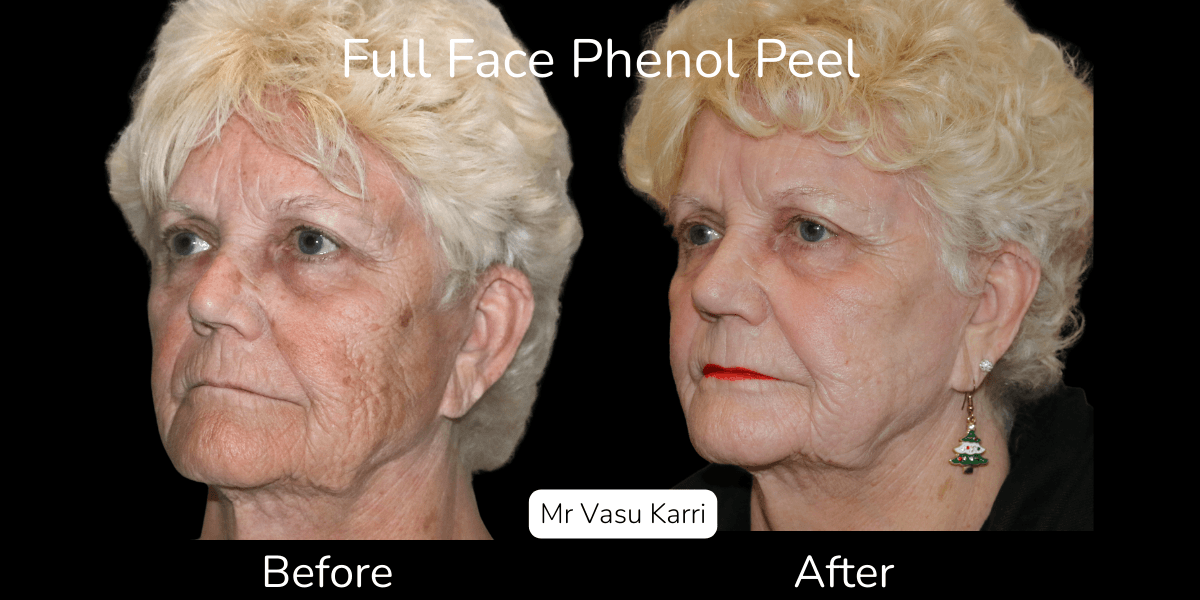
Many of you are looking for non-surgical facelift alternatives that give more than a mild freshen-up. Deep phenol–croton oil peels are one of the few skin treatments where a single session can produce visible tightening that often lasts for years. Did you know that, in a recent study of phenol–croton oil peels around the eyes, about 89% of treated areas showed more than 50% improvement, with benefits typically lasting around two years or longer?
Key Takeaways
| Common Question | Short Answer |
|---|---|
| How does a phenol peel tighten skin? | It is a deep peel facial rejuvenation treatment that removes damaged surface layers and triggers strong collagen stimulation in the deeper dermis, which can lead to firmer, tighter skin. |
| Is a phenol peel a real alternative to a facelift? | Phenol peels are one of the strongest non-surgical facelift alternatives. They improve fine lines, deep wrinkles, and skin laxity, especially on the face, though they do not reposition deeper tissues like surgery. |
| How long do tightening results last? | Studies suggest improvement can last around 2 years or more for many patients, making phenol peels one of the most durable peel-based skin laxity treatments. |
| Where can you get a phenol peel in the UK? | Mr Karri performs phenol peels at Kinvara Private Hospital, Rotherham, South Yorkshire. |
| What downtime should you expect? | Most people need around 2 weeks off work, with redness and skin maturation continuing for several weeks or months. Strict sun care is essential. |
| Is phenol peel skin tightening safe? | It can be safe in experienced hands with proper monitoring. Because phenol is absorbed systemically, reputable clinics use careful dosing, heart monitoring, and thorough pre-assessment. |
| Who is not suitable? | Those of you with darker skin tones, certain heart conditions, or unrealistic expectations may be advised against phenol peels and guided to other chemical peel for sagging skin options. |
How Phenol Peels Tighten Skin: The Science Behind the Results
A phenol peel is a type of deep chemical peel for sagging skin, usually using a mix of phenol and croton oil. This solution penetrates through the epidermis and into the upper and mid-dermis, where collagen fibres sit. By reaching this depth, the peel creates a controlled injury that stimulates new collagen and elastin, leading to smoother, firmer skin once healing is complete.
During treatment, your practitioner applies the phenol–croton oil solution in small sections, often producing a white "frosting" of the skin. Over days, the outer layers peel away, revealing a new surface that is often tighter, more even in colour, and less lined. In expert hands, this makes phenol peel skin tightening one of the most powerful non-surgical options for advanced photoageing.
Phenol Peel vs Other Non-Surgical Facelift Alternatives
Many of you compare phenol peels with treatments such as medium-depth chemical peels, microneedling, radiofrequency and high-intensity focused ultrasound. Those options often give gentler results but require multiple sessions and may not fully address deep wrinkles and marked laxity. A phenol peel, by contrast, is a one-off deep peel facial rejuvenation procedure aimed at more severe sun damage and lines.
While a facelift repositions deeper facial tissues, a phenol peel focuses on the skin itself. For some of you, especially where crepey texture, etched-in lines around the mouth, or heavy sun damage are the main issues, a phenol peel can act as a powerful skin resurfacing and tightening treatment, either alone or combined with surgery. At Kinvara Private Hospital, prices start from £650 for lower eyelid wrinkles or wrinkles around the mouth, and £3000 for a full-face phenol peel.
What Phenol Peel Skin Tightening Can Treat
Phenol peels are often called the "gold standard" for advanced facial photoageing. As a strong skin laxity treatment, they are usually used on the face to treat deep wrinkles, smoker's lines around the mouth, loose skin on the lower eyelids and cheeks, and coarse texture from long-term sun exposure. Many of you also notice brighter, more even skin tone once healing is complete.
Areas commonly treated with phenol peels include the perioral region (around the mouth), periorbital region (around the eyes), and, in some cases, the full face. Each area requires a tailored approach, with the peel depth and formula adjusted to the thickness and sensitivity of the skin. The lower eyelids, for example, need a gentler concentration to avoid excessive thinning or pigment change, while the cheeks and chin can often tolerate stronger treatment.
How Long Do Skin-Tightening Results Last?
One of the reasons phenol peels appeal as a non-surgical facelift alternative is their durability. Evidence suggests that improvements in wrinkles and texture can last several years, with some patients enjoying visible benefits for a decade or more. A study of phenol–croton oil peels for periorbital dark circles, for instance, reported an average improvement duration of around two years, though some patients maintained results for much longer.
Over time, your skin continues to age, so you will gradually develop new lines and experience some relaxation of tissues. However, many of you find that the "clock has been turned back" significantly by the peel, and the skin remains smoother and firmer than it would have been without treatment. Good sun protection, healthy habits and appropriate maintenance skincare help preserve results.
Who Is a Good Candidate for Phenol Peel Skin Tightening?
Phenol peels work best on fair-skinned individuals with significant sun damage, deep wrinkles or loose skin that has not responded well to less aggressive treatments. Those of you with darker skin types (Fitzpatrick IV-VI) carry a higher risk of pigment changes, so many clinicians will either avoid phenol peels in these groups or use very conservative, limited approaches if appropriate at all.
Good overall health is essential, because phenol can affect the heart and other organs. Your practitioner will carefully review your medical history, current medications, and any heart, liver or kidney issues before agreeing to proceed. Realistic expectations, commitment to aftercare and the ability to take time off work for recovery are also important parts of being a suitable candidate.
Risks, Side Effects and Safety Considerations
Phenol peel skin tightening is a powerful procedure, so it carries higher risks than lighter peels. Short-term side effects usually include redness, swelling, oozing, crusting and tightness during the first one to two weeks. As healing progresses, redness can persist for several weeks to months, and you will need strict sun avoidance to reduce the risk of pigment changes.
More serious risks, though less common in expert hands, include scarring, long-term pigment loss or darkening, infection, and delayed healing. Because phenol is absorbed into the bloodstream and can affect the heart, reputable clinics involve close monitoring of heart rhythm and blood pressure during treatment. Choosing a practitioner who regularly performs deep phenol peels and follows evidence-based protocols is vital for safe, effective results.
Recovery, Downtime and Long-Term Maintenance
For the first week, many of you will have a protective ointment or dressing on the face, with swelling and tightness being most noticeable around days two to four. By the end of week one, crusts usually start to fall away, revealing a bright pink new surface. Most patients can return to office-based work and light activities after around two weeks, though redness may still be visible and can be covered with suitable make-up approved by your practitioner.
Over the following months, redness fades and your skin continues to remodel. Sun protection with high-SPF broad-spectrum sunscreen, hats and shade is essential to protect your results. Some of you will complement your phenol peel with medical-grade skincare, gentle maintenance peels, or other treatments once your practitioner confirms that the skin is fully stable.
Phenol Peel Skin Tightening at Kinvara Private Hospital
Access to experienced phenol peel practitioners is important, as this is a specialist deep peel facial rejuvenation technique. Mr Karri at Kinvara Private Hospital provides this treatment with comprehensive pre-treatment consultations and post-procedure reviews so you are supported throughout healing.
Fees vary depending on the area treated. Targeted areas such as lower eyelid wrinkles or wrinkles around the mouth can be around £650, while a full-face phenol peel can be around £3000.
Comparing Phenol Peels with Other Deep Chemical Peel Options
Some of you may have experience with medium-depth peels such as trichloroacetic acid (TCA). These can improve pigmentation and fine lines, but their tightening effect is usually more modest and often shorter-lived than a phenol–croton oil peel. A phenol peel typically reaches deeper, giving stronger collagen stimulation and more dramatic skin tightening, particularly for marked perioral and periocular ageing.
For those of you with advanced skin ageing, phenol peels may be the only peel-based route that offers facelift-like improvements to skin texture and tightness.
Frequently Asked Questions About Phenol Peel Skin Tightening
1. How soon will you notice skin tightening after a phenol peel?
Most of you start to notice tightening and smoothing as the new skin appears over the first few weeks. The full effect, especially from collagen remodelling, usually develops over three to six months.
2. Can phenol peel skin tightening be repeated?
Because phenol peels are very deep, repeat full-face treatments are not common. Limited or regional touch-up peels may be considered years later, but this must be judged case by case by an experienced practitioner.
3. Is phenol peel skin tightening painful?
The procedure can be uncomfortable, so clinics use local anaesthetic, sedation or other measures to keep you as comfortable as possible. Post-treatment, tightness and burning sensations often settle over several days with prescribed pain relief and cooling measures.
4. Can you combine phenol peel skin tightening with other treatments?
Yes, many clinics combine phenol peels with procedures such as facelifts, eyelid surgery, or later with injectables and skincare. The timing is important, so your practitioner will plan combinations carefully to protect the skin.
5. Will phenol peel skin tightening help acne scars?
Phenol peels are mainly aimed at wrinkles and photoageing, but they can improve some forms of superficial acne scarring by resurfacing and tightening the skin. Deep, pitted scars may still need other treatments such as subcision or targeted resurfacing.
6. How long should you stay out of the sun after a phenol peel?
You should avoid direct sun exposure as much as possible for several months. When you do go outside, use broad-spectrum sunscreen, hats and shade consistently to protect the new skin and reduce pigment problems.
7. Does phenol peel skin tightening work on the neck?
Phenol peels are usually reserved for the face because the neck and other body areas heal differently and carry higher risk. Some practitioners use adjusted protocols off the face, but this is more complex and must be assessed individually.
Conclusion
Phenol peel skin tightening offers a rare combination: a single treatment that can significantly smooth wrinkles, firm lax skin and improve texture for many years. By acting as a deep collagen stimulation peel, it sits apart from lighter peels and many other non-surgical facelift alternatives, making it a strong option for those of you with advanced photoageing who are prepared for downtime.
This strength comes with greater responsibility, both for you and your practitioner. Careful selection, thorough consultation, heart and blood pressure monitoring, and diligent aftercare all play key roles in achieving safe, satisfying results. If you are considering a phenol peel, seeking out an experienced specialist like Mr Karri at Kinvara Private Hospital and discussing your goals, health and lifestyle in detail is the best starting point for deciding whether this deep peel facial rejuvenation treatment is right for you.
Mr Karri's phenol peel practice draws patients nationwide, serving patients from major cities and towns across England, Scotland, and Wales:
Bedfordshire | Berkshire | Bristol | Buckinghamshire | Cambridgeshire | Cheshire | Cornwall | County Durham | Cumbria | Derbyshire | Devon | Dorset | East Sussex | Essex | Gloucestershire | London | Manchester | Hampshire | Herefordshire | Hertfordshire | Kent | Lancashire | Leicestershire | Lincolnshire | Merseyside | Norfolk | North Yorkshire | Northamptonshire | Northumberland | Nottinghamshire | Oxfordshire | Shropshire | Somerset | South Yorkshire | Staffordshire | Suffolk | Surrey | Tyne and Wear | Warwickshire | West Midlands | West Sussex | West Yorkshire | Wiltshire | Worcestershire | Birmingham | Leeds | Sheffield | Liverpool | Newcastle | Nottingham